Redis之sql缓存的具体使用
来到golang学习网的大家,相信都是编程学习爱好者,希望在这里学习数据库相关编程知识。下面本篇文章就来带大家聊聊《Redis之sql缓存的具体使用》,介绍一下缓存、Redissql,希望对大家的知识积累有所帮助,助力实战开发!
1.环境搭建
org.springframework.boot spring-boot-starter-data-redis
spring:
  redis:
    host: 192.168.8.128
    port: 6380
    password: 1234
    database: 0
    timeout: 3000
    jedis:
      pool:
        max-wait: -1
        max-active: -1
        max-idle: 20
        min-idle: 10
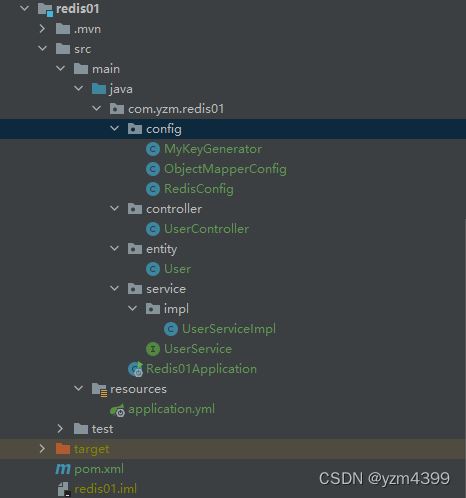
2.Redis配置
package com.yzm.redis01.config;

import com.fasterxml.jackson.annotation.JsonAutoDetect;
import com.fasterxml.jackson.annotation.JsonInclude;
import com.fasterxml.jackson.annotation.JsonTypeInfo;
import com.fasterxml.jackson.annotation.PropertyAccessor;
import com.fasterxml.jackson.core.JsonGenerator;
import com.fasterxml.jackson.core.JsonParser;
import com.fasterxml.jackson.databind.*;
import com.fasterxml.jackson.datatype.jsr310.JavaTimeModule;
import org.springframework.context.annotation.Bean;
import org.springframework.context.annotation.Configuration;

import java.io.IOException;
import java.text.SimpleDateFormat;
import java.time.LocalDateTime;
import java.time.format.DateTimeFormatter;

@Configuration
public class ObjectMapperConfig {

    private static final String PATTERN = "yyyy-MM-dd HH:mm:ss";

    @Bean(name = "myObjectMapper")
    public ObjectMapper objectMapper() {
        JavaTimeModule javaTimeModule = new JavaTimeModule();
        javaTimeModule.addSerializer(LocalDateTime.class, new LocalDateTimeSerializer());
        javaTimeModule.addDeserializer(LocalDateTime.class, new LocalDateTimeDeserializer());
        return new ObjectMapper()
                // 转换为格式化的json(控制台打印时,自动格式化规范)
                //.enable(SerializationFeature.INDENT_OUTPUT)
                // Include.ALWAYS  是序列化对像所有属性(默认)
                // Include.NON_NULL 只有不为null的字段才被序列化,属性为NULL 不序列化
                // Include.NON_EMPTY 如果为null或者 空字符串和空集合都不会被序列化
                // Include.NON_DEFAULT 属性为默认值不序列化
                .setSerializationInclusion(JsonInclude.Include.NON_NULL)
                // 如果是空对象的时候,不抛异常
                .configure(SerializationFeature.FAIL_ON_EMPTY_BEANS, false)
                // 反序列化的时候如果多了其他属性,不抛出异常
                .configure(DeserializationFeature.FAIL_ON_UNKNOWN_PROPERTIES, false)
                // 取消时间的转化格式,默认是时间戳,可以取消,同时需要设置要表现的时间格式
                .configure(SerializationFeature.WRITE_DATES_AS_TIMESTAMPS, false)
                .setDateFormat(new SimpleDateFormat(PATTERN))
                // 对LocalDateTime序列化跟反序列化
                .registerModule(javaTimeModule)

                .setVisibility(PropertyAccessor.ALL, JsonAutoDetect.Visibility.ANY)
                // 此项必须配置,否则会报java.lang.ClassCastException: java.util.LinkedHashMap cannot be cast to XXX
                .enableDefaultTyping(ObjectMapper.DefaultTyping.NON_FINAL, JsonTypeInfo.As.PROPERTY)
                ;
    }

    static class LocalDateTimeSerializer extends JsonSerializer {
        @Override
        public void serialize(LocalDateTime value, JsonGenerator gen, SerializerProvider serializers) throws IOException {
            gen.writeString(value.format(DateTimeFormatter.ofPattern(PATTERN)));
        }
    }

    static class LocalDateTimeDeserializer extends JsonDeserializer {
        @Override
        public LocalDateTime deserialize(JsonParser p, DeserializationContext deserializationContext) throws IOException {
            return LocalDateTime.parse(p.getValueAsString(), DateTimeFormatter.ofPattern(PATTERN));
        }
    }
}
package com.yzm.redis01.config;

import lombok.extern.slf4j.Slf4j;
import org.springframework.cache.interceptor.KeyGenerator;
import org.springframework.cache.interceptor.SimpleKey;

import java.lang.reflect.Method;
import java.util.Arrays;
/**
 * key生成器
 */
@Slf4j
public class MyKeyGenerator implements KeyGenerator {

    private static final String NO_PARAM = "[]";
    private static final String NULL_PARAM = "_";

    @Override
    public Object generate(Object target, Method method, Object... params) {
        StringBuilder key = new StringBuilder();
        key.append(target.getClass().getSimpleName()).append(".").append(method.getName()).append(":");

        if (params.length == 0) {
            return new SimpleKey(key.append(NO_PARAM).toString());
        }

        return new SimpleKey(key.append(Arrays.toString(params).replace("null", NULL_PARAM)).toString());
    }
}
package com.yzm.redis01.config;
import com.fasterxml.jackson.databind.ObjectMapper;
import org.springframework.cache.CacheManager;
import org.springframework.cache.annotation.EnableCaching;
import org.springframework.context.annotation.Bean;
import org.springframework.context.annotation.Configuration;
import org.springframework.data.redis.cache.RedisCacheConfiguration;
import org.springframework.data.redis.cache.RedisCacheManager;
import org.springframework.data.redis.cache.RedisCacheWriter;
import org.springframework.data.redis.connection.RedisConnectionFactory;
import org.springframework.data.redis.core.*;
import org.springframework.data.redis.serializer.Jackson2JsonRedisSerializer;
import org.springframework.data.redis.serializer.RedisSerializationContext;
import org.springframework.data.redis.serializer.StringRedisSerializer;
import javax.annotation.Resource;
import java.time.Duration;
@Configuration
@EnableCaching // 启动缓存
public class RedisConfig {
@Bean(name = "myKeyGenerator")
public MyKeyGenerator myKeyGenerator() {
return new MyKeyGenerator();
}
@Resource(name = "myObjectMapper")
private ObjectMapper objectMapper;
/**
* 选择redis作为默认缓存工具
*/
@Bean
public CacheManager cacheManager(RedisConnectionFactory connectionFactory) {
RedisCacheWriter redisCacheWriter = RedisCacheWriter.nonLockingRedisCacheWriter(connectionFactory);
RedisCacheConfiguration cacheConfiguration = RedisCacheConfiguration
.defaultCacheConfig()
// 默认缓存时间(秒)
.entryTtl(Duration.ofSeconds(300L))
// 序列化key、value
.serializeKeysWith(RedisSerializationContext.SerializationPair.fromSerializer(new StringRedisSerializer()))
.serializeValuesWith(RedisSerializationContext.SerializationPair.fromSerializer(jackson2JsonRedisSerializer()))
// 禁用缓存空值
.disableCachingNullValues();
return new RedisCacheManager(redisCacheWriter, cacheConfiguration);
}
/**
* redisTemplate配置
*/
@Bean
public RedisTemplate redisTemplate(RedisConnectionFactory factory) {
RedisTemplate template = new RedisTemplate();
// 配置连接工厂
template.setConnectionFactory(factory);
Jackson2JsonRedisSerializer
3.功能实现
新增、更新、删除、查询数据时,对缓存执行对应相同的操作
package com.yzm.redis01.entity;

import lombok.AllArgsConstructor;
import lombok.Builder;
import lombok.Data;
import lombok.NoArgsConstructor;
import lombok.experimental.Accessors;

import java.io.Serializable;
import java.time.LocalDateTime;
import java.util.Date;

@Data
@Builder
@NoArgsConstructor
@AllArgsConstructor
@Accessors(chain = true)
public class User implements Serializable {
    private static final long serialVersionUID = -2468903864827432779L;
    private Integer id;
    private String username;
    private String password;
    private Date createDate;
    private LocalDateTime updateDate;
}
package com.yzm.redis01.service;

import com.yzm.redis01.entity.User;

import java.util.List;

public interface UserService {

    User saveUser(User user);

    User updateUser(User user);

    int deleteUser(Integer id);

    void deleteAllCache();

    User getUserById(Integer id);

    List selectAll();

	List findAll(Object... params);
}
为了简便,数据不从数据库获取,这里是创建Map存储数据实现
package com.yzm.redis01.service.impl;

import com.yzm.redis01.entity.User;
import com.yzm.redis01.service.UserService;
import lombok.extern.slf4j.Slf4j;
import org.springframework.cache.annotation.CacheConfig;
import org.springframework.cache.annotation.CacheEvict;
import org.springframework.cache.annotation.CachePut;
import org.springframework.cache.annotation.Cacheable;
import org.springframework.stereotype.Service;

import java.time.LocalDateTime;
import java.util.*;

@Slf4j
@Service
@CacheConfig(cacheNames = "users")
public class UserServiceImpl implements UserService {


    private static final Map userMap;

    static {
        userMap = new HashMap();
        userMap.put(userMap.size() + 1, User.builder()
                .id(userMap.size() + 1).username("root").password("root").createDate(new Date()).updateDate(LocalDateTime.now()).build());
        userMap.put(userMap.size() + 1, User.builder()
                .id(userMap.size() + 1).username("admin").password("admin").createDate(new Date()).updateDate(LocalDateTime.now()).build());
    }

    @Override
    @CachePut(key = "#result.id", condition = "#result.id gt 0")
    public User saveUser(User user) {
        log.info("保存数据");
        int id = userMap.size() + 1;
        User build = User.builder()
                .id(id)
                .username(user.getUsername())
                .password(user.getPassword())
                .createDate(new Date())
                .updateDate(LocalDateTime.now())
                .build();
        userMap.put(id, build);
        return build;
    }

    @Override
    @CachePut(key = "#user.id", unless = "#result eq null")
    public User updateUser(User user) {
        log.info("更新数据");
        if (userMap.containsKey(user.getId())) {
            User update = userMap.get(user.getId());
            update.setUsername(user.getUsername())
                    .setPassword(user.getPassword())
                    .setUpdateDate(LocalDateTime.now());
            userMap.replace(user.getId(), update);
            return update;
        }
        return null;
    }

    @Override
    @CacheEvict(key = "#id", condition = "#result gt 0")
    public int deleteUser(Integer id) {
        log.info("删除数据");
        if (userMap.containsKey(id)) {
            userMap.remove(id);
            return 1;
        }
        return 0;
    }

    @Override
    @CacheEvict(allEntries = true)
    public void deleteAllCache() {
        log.info("清空缓存");
    }

    @Override
    @Cacheable(key = "#id", condition = "#id gt 1")
    public User getUserById(Integer id) {
        log.info("查询用户");
        return userMap.get(id);
    }

    @Override
    @Cacheable(key = "#root.methodName")
    public List selectAll() {
        log.info("查询所有");
        return new ArrayList(userMap.values());
    }

    @Override
    @Cacheable(keyGenerator = "myKeyGenerator")
    public List findAll(Object... params) {
        log.info("查询所有");
        return new ArrayList(userMap.values());
    }

}
package com.yzm.redis01.controller;

import com.yzm.redis01.entity.User;
import com.yzm.redis01.service.UserService;
import org.springframework.web.bind.annotation.GetMapping;
import org.springframework.web.bind.annotation.RequestMapping;
import org.springframework.web.bind.annotation.RequestParam;
import org.springframework.web.bind.annotation.RestController;

import java.util.List;

@RestController
@RequestMapping("/user")
public class UserController {

    private final UserService userService;

    public UserController(UserService userService) {
        this.userService = userService;
    }

    @GetMapping("/saveUser")
    public void saveUser() {
        User user = new User();
        user.setUsername("yzm");
        user.setPassword("yzm");
        System.out.println(userService.saveUser(user));
    }

    @GetMapping("/updateUser")
    public void updateUser(Integer id) {
        User user = new User();
        user.setId(id);
        user.setUsername("yzm");
        user.setPassword("123");
        System.out.println(userService.updateUser(user));
    }

    @GetMapping("/deleteUser")
    public void deleteUser(@RequestParam Integer id) {
        System.out.println(userService.deleteUser(id));
    }

    @GetMapping("/deleteAllCache")
    public void deleteAllCache() {
        userService.deleteAllCache();
    }

    @GetMapping("/getUserById")
    public void getUserById(@RequestParam Integer id) {
        System.out.println(userService.getUserById(id));
    }

    @GetMapping("/selectAll")
    public void selectAll() {
        List users = userService.selectAll();
        users.forEach(System.out::println);
    }
}
4.缓存注解的使用说明
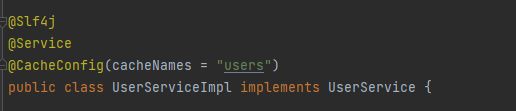
@CacheConfig:注解在类上,表示该类所有缓存方法使用统一指定的缓存区,也可以作用在方法上
@CacheAble:注解在方法上,应用到读数据的方法上,如查找方法:调用方法之前根据条件判断是否从缓存获取相应的数据,缓存没有数据,方法执行后添加到缓存
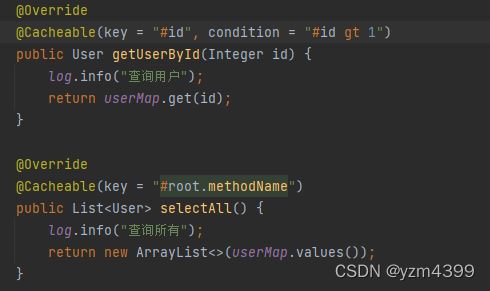
#id 直接使用参数名
#p0 p0对应参数列表的第一个参数,以此类推
#user.id 参数是对象时,使用对象属性
#root. 可以点出很多方法
#root.methodName
#result 返回值
http://localhost:8080/user/getUserById?id=1
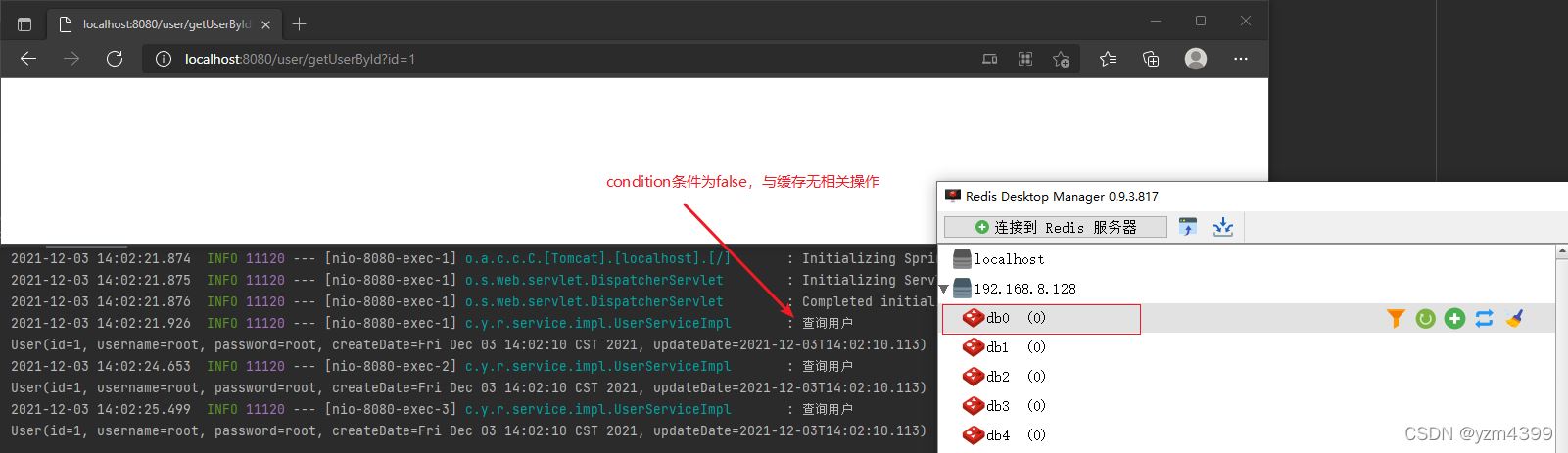
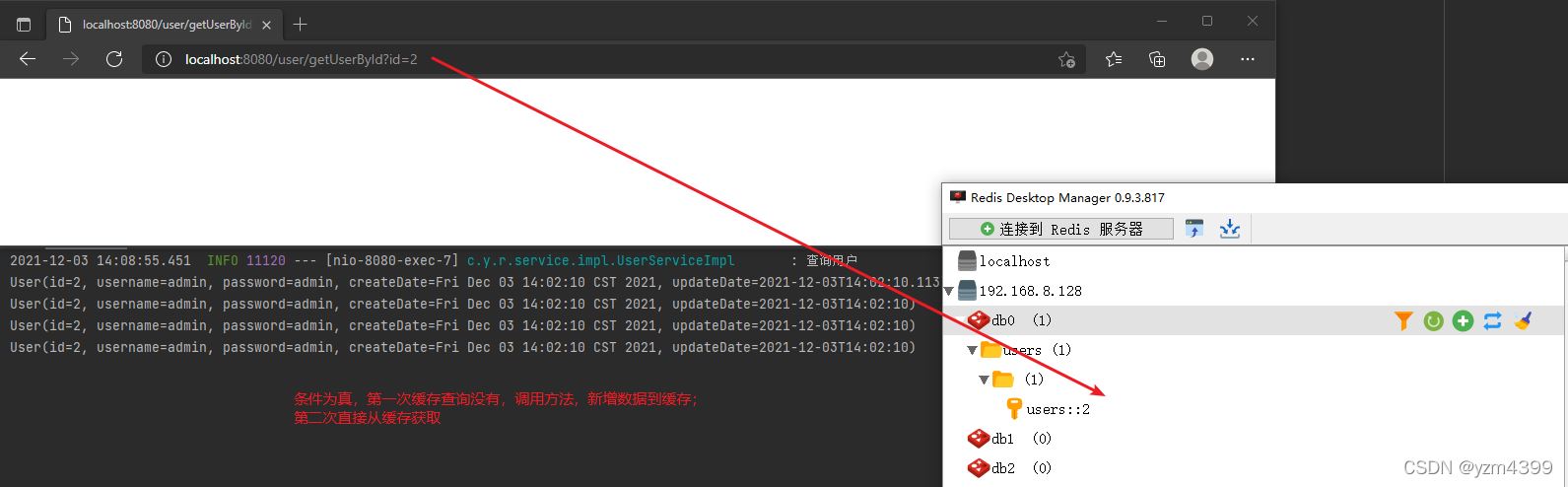
http://localhost:8080/user/getUserById?id=2
http://localhost:8080/user/selectAll
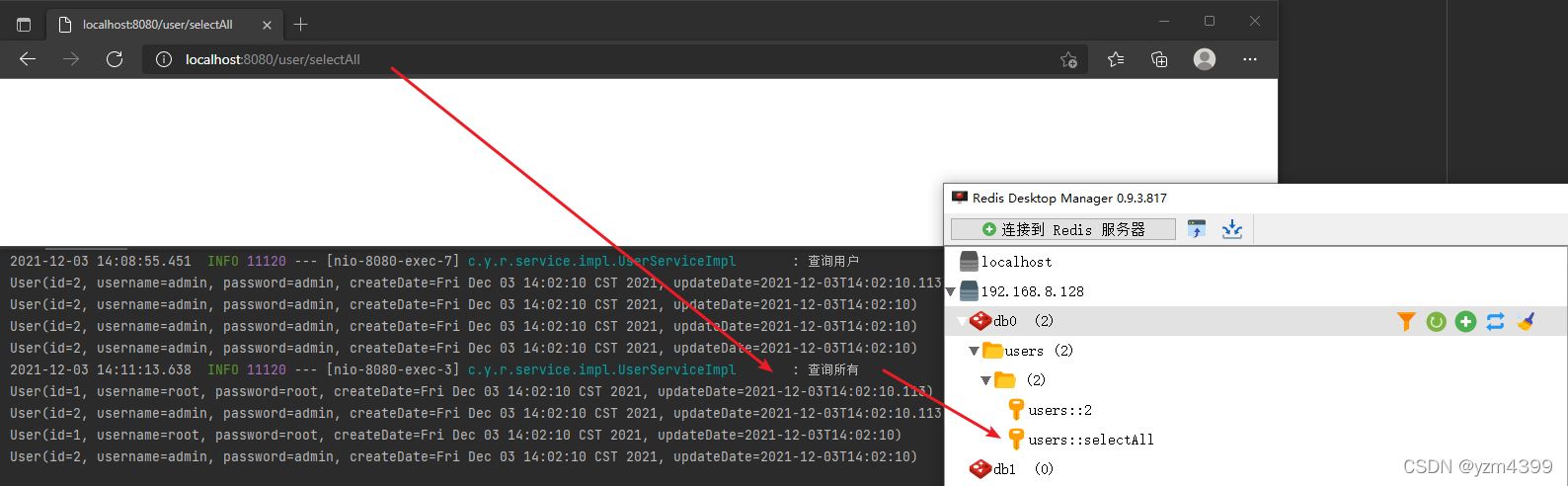
@Cacheable运行流程:在调用方法之前判断condition,如果为true,则查缓存;没有缓存就调用方法并将数据添加到缓存;condition=false就与缓存无关了
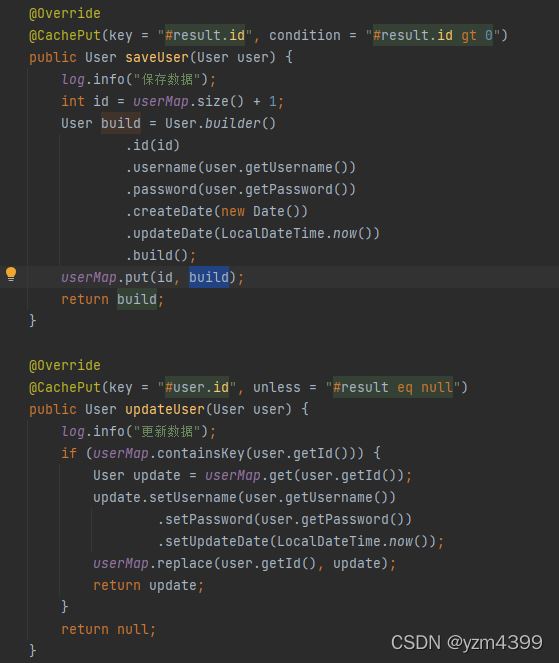
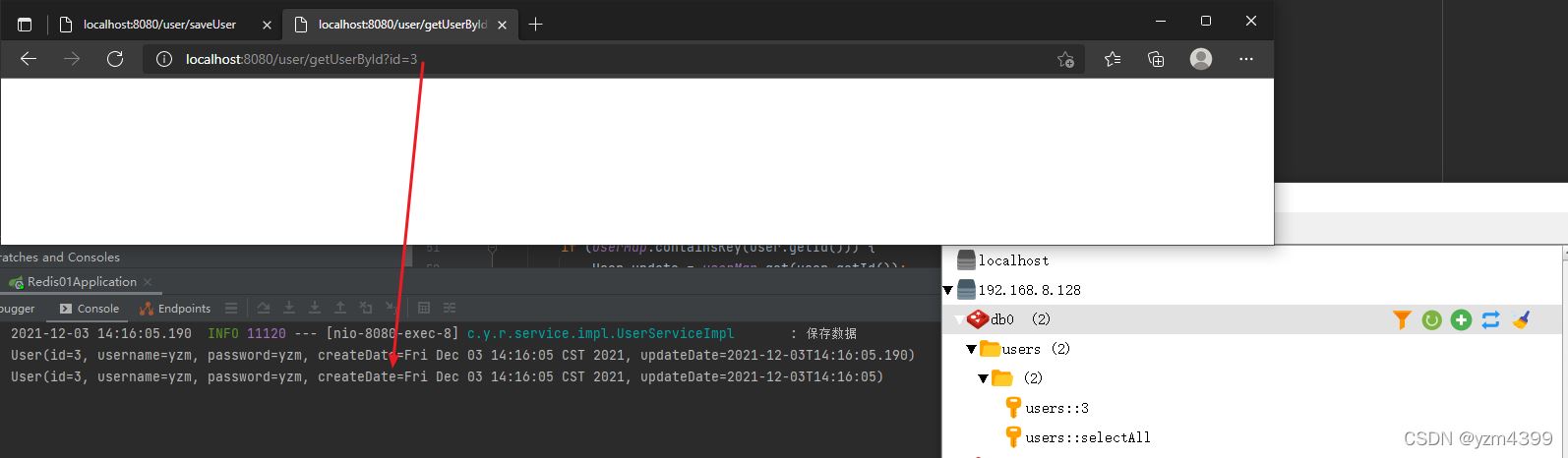
@CachePut:注解在方法上,应用到写数据的方法上,如新增/修改方法,调用方法之后根据条件判断是否添加/更新相应的数据到缓存:
http://localhost:8080/user/saveUser
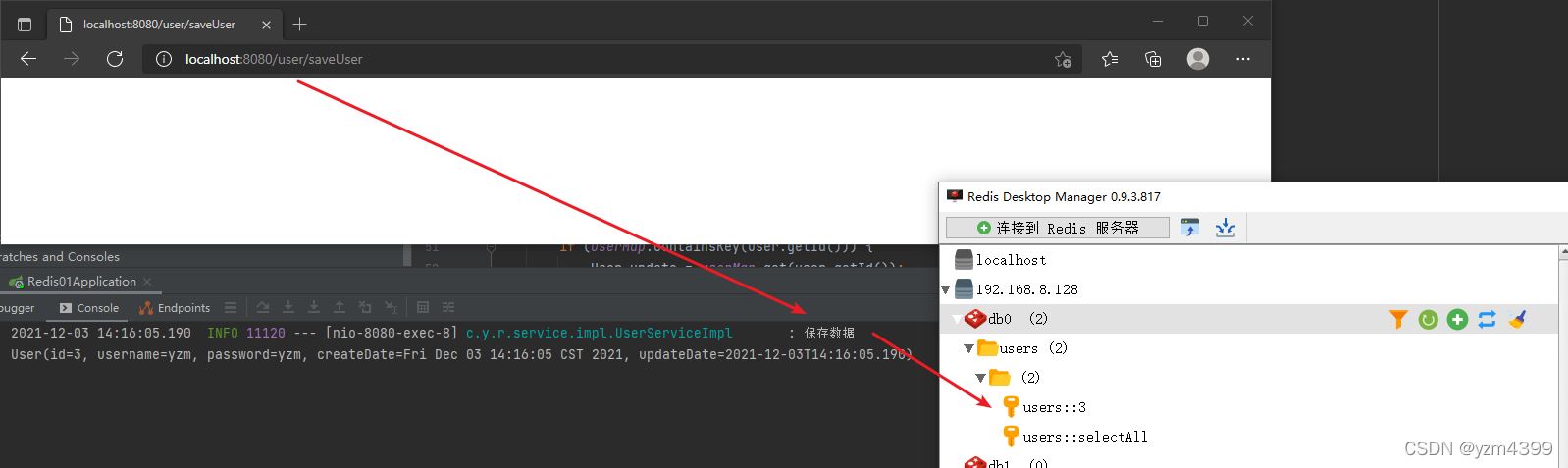
condition条件为true,添加到缓存,根据id查询直接从缓存获取
http://localhost:8080/user/getUserById?id=3
http://localhost:8080/user/updateUser?id=3
http://localhost:8080/user/getUserById?id=3
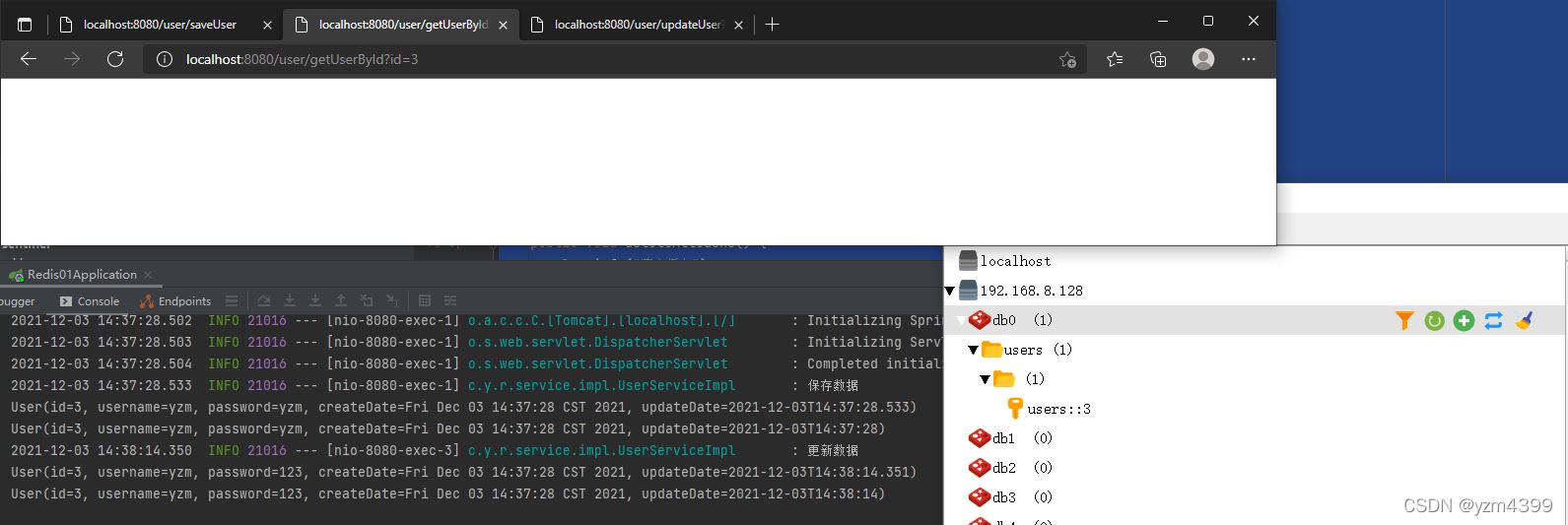
条件condition=true,执行缓存操作
条件unless=false,执行缓存操作;跟condition相反
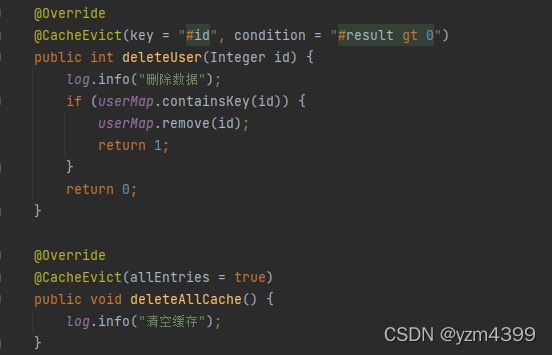
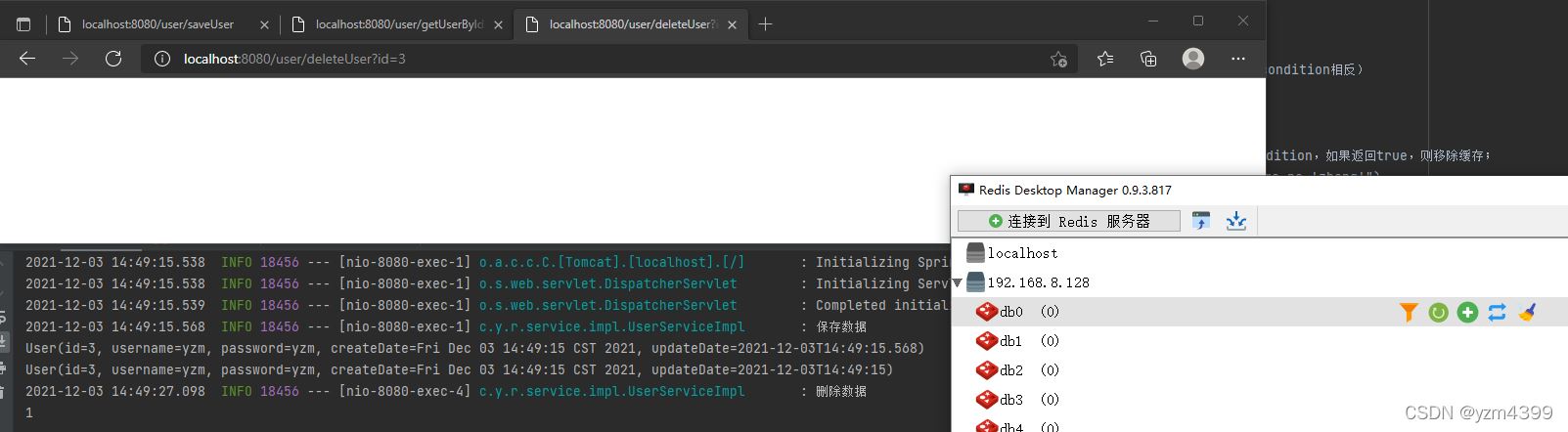
@CacheEvict 注解在方法上,应用到删除数据的方法上,如删除方法,调用方法之后根据条件判断是否从缓存中移除相应的数据
http://localhost:8080/user/saveUser
http://localhost:8080/user/getUserById?id=3
http://localhost:8080/user/deleteUser?id=3
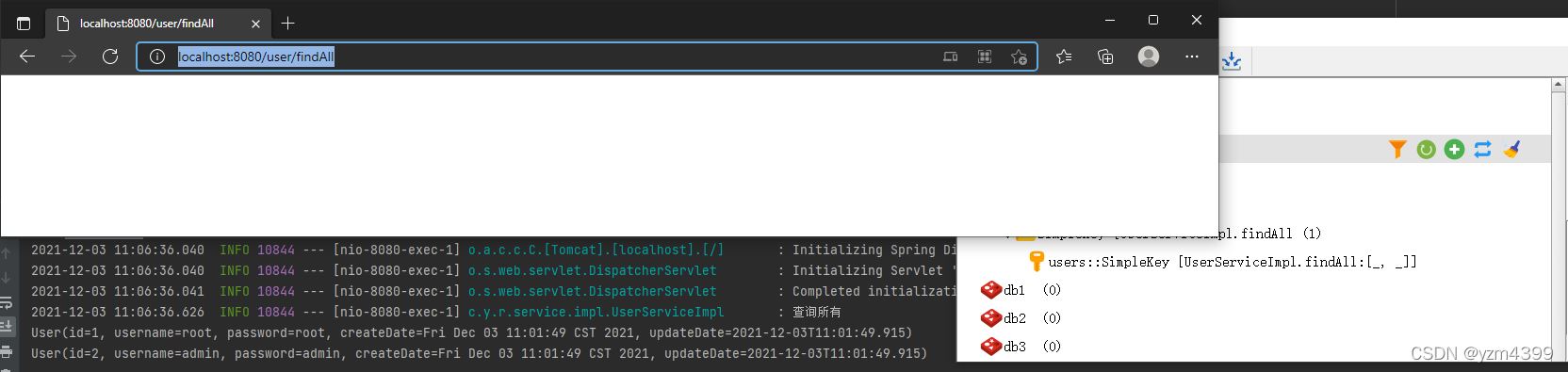
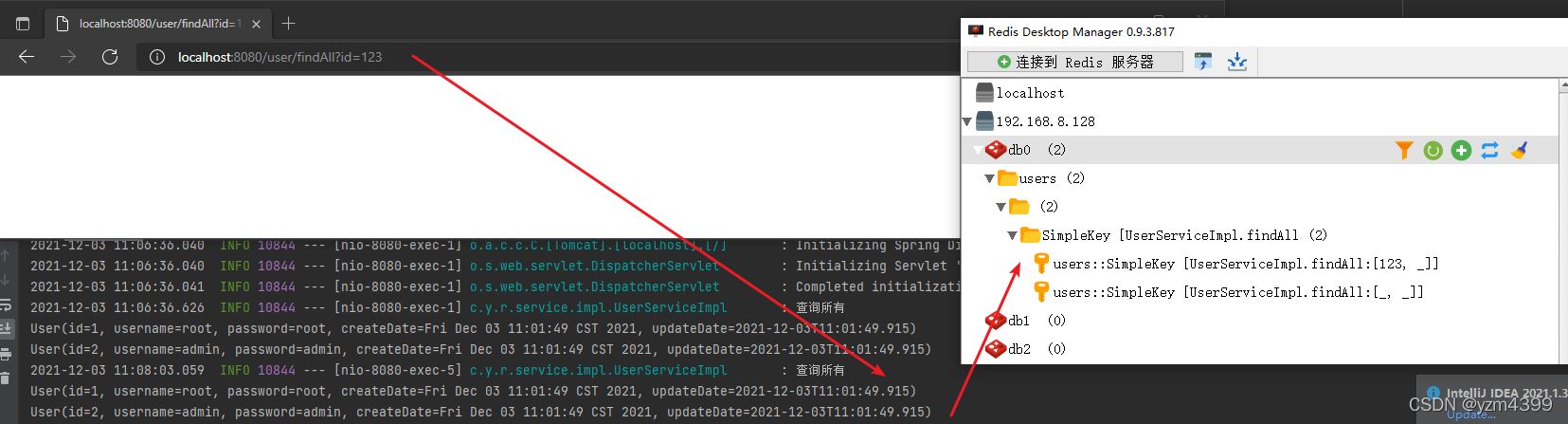
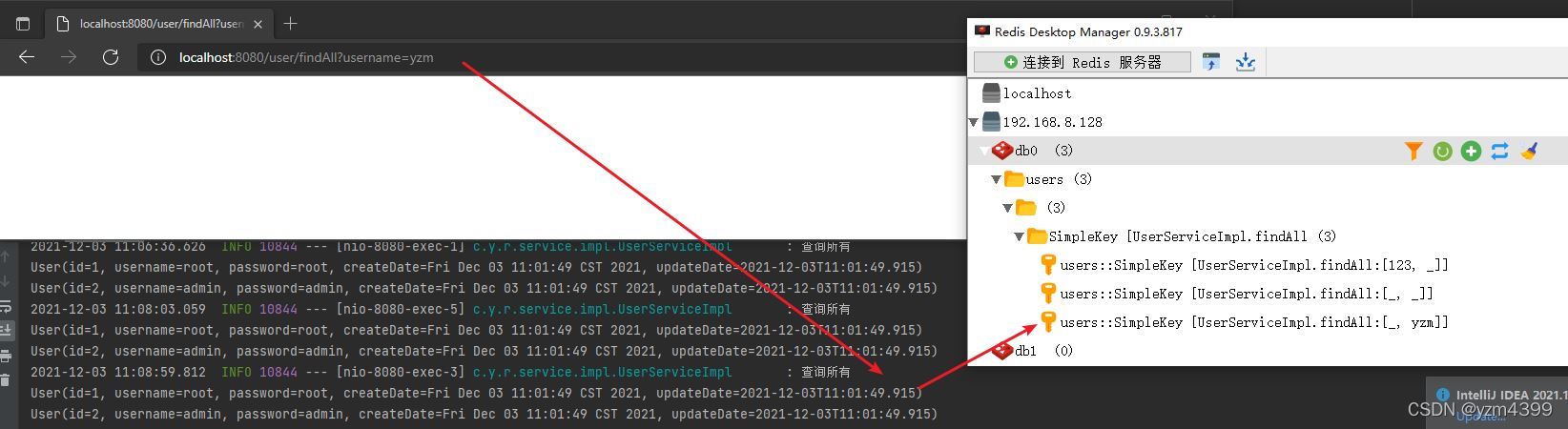
自定义缓存key自动生成器
    @Override
    @Cacheable(keyGenerator = "myKeyGenerator")
    public List findAll(Object... params) {
        log.info("查询所有");
        return new ArrayList(userMap.values());
    }
@Slf4j
public class MyKeyGenerator implements KeyGenerator {

    private static final String NO_PARAM = "[]";
    private static final String NULL_PARAM = "_";

    @Override
    public Object generate(Object target, Method method, Object... params) {
        StringBuilder key = new StringBuilder();
        key.append(target.getClass().getSimpleName()).append(".").append(method.getName()).append(":");

        if (params.length == 0) {
            return new SimpleKey(key.append(NO_PARAM).toString());
        }

        return new SimpleKey(key.append(Arrays.toString(params).replace("null", NULL_PARAM)).toString());
    }
}
http://localhost:8080/user/findAll
http://localhost:8080/user/findAll?id=123
http://localhost:8080/user/findAll?username=yzm
@Caching
有时候我们可能组合多个Cache注解使用;比如用户新增成功后,我们要添加id–>user;username—>user;email—>user的缓存;
此时就需要@Caching组合多个注解标签了。
@Caching(
    put = {
        @CachePut(value = "users", key = "#user.id"),
        @CachePut(value = "users", key = "#user.username"),
        @CachePut(value = "users", key = "#user.email")
    }
)
public User save(User user) {}
以上就是本文的全部内容了,是否有顺利帮助你解决问题?若是能给你带来学习上的帮助,请大家多多支持golang学习网!更多关于数据库的相关知识,也可关注golang学习网公众号。
 使用Redis实现令牌桶算法原理解析
- 上一篇
- 使用Redis实现令牌桶算法原理解析
- 下一篇
- Redis分布式锁详细介绍
-

- 缓慢的帆布鞋
- 这篇技术文章真是及时雨啊,好细啊,太给力了,码起来,关注楼主了!希望楼主能多写数据库相关的文章。
- 2023-01-28 01:03:49
-
- 知性的楼房
- 这篇文章内容真及时,很详细,感谢大佬分享,码起来,关注老哥了!希望老哥能多写数据库相关的文章。
- 2023-01-09 16:57:21
-
- 义气的豆芽
- 太详细了,已收藏,感谢作者的这篇文章,我会继续支持!
- 2023-01-07 00:43:18
-
- 甜美的美女
- 很有用,一直没懂这个问题,但其实工作中常常有遇到...不过今天到这,看完之后很有帮助,总算是懂了,感谢博主分享文章!
- 2023-01-06 17:47:35
-
- 独特的发夹
- 好细啊,码起来,感谢作者的这篇技术文章,我会继续支持!
- 2023-01-03 21:30:31
-
- 激昂的老师
- 这篇博文真及时,很详细,赞 ??,收藏了,关注楼主了!希望楼主能多写数据库相关的文章。
- 2023-01-03 01:53:06
-
- 顺利的服饰
- 很好,一直没懂这个问题,但其实工作中常常有遇到...不过今天到这,看完之后很有帮助,总算是懂了,感谢作者大大分享技术文章!
- 2023-01-02 21:31:16
-
- 迅速的皮带
- 这篇博文真是及时雨啊,太细致了,很好,码住,关注up主了!希望up主能多写数据库相关的文章。
- 2022-12-31 19:32:07
-
- 爱听歌的短靴
- 写的不错,一直没懂这个问题,但其实工作中常常有遇到...不过今天到这,看完之后很有帮助,总算是懂了,感谢up主分享技术文章!
- 2022-12-31 18:05:49
-
- 数据库 · Redis | 2小时前 |
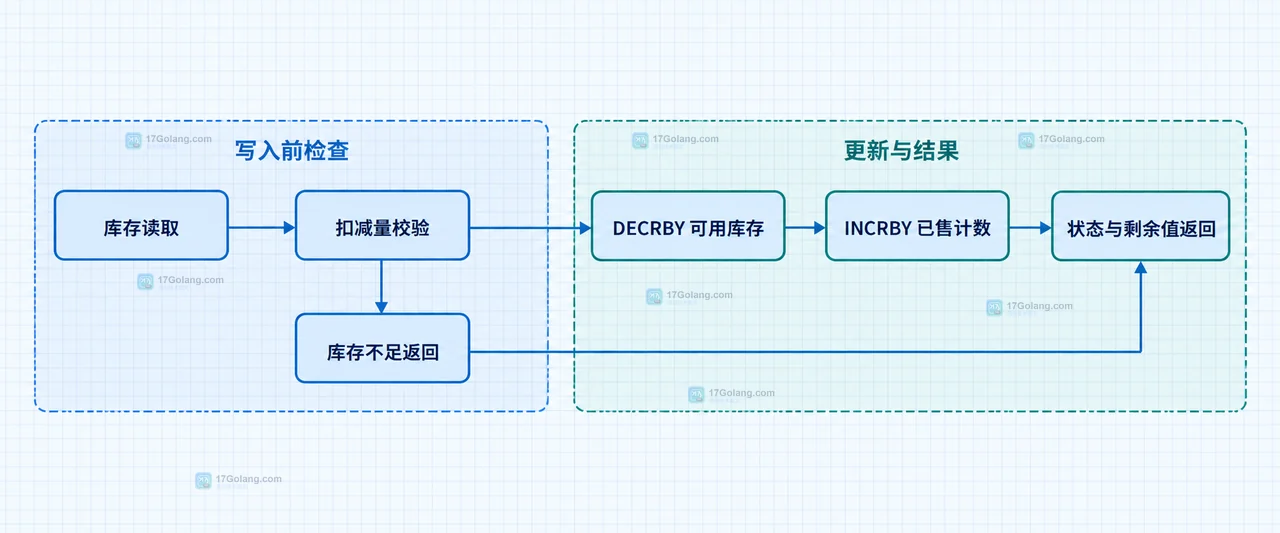
- Redis Lua 脚本中如何保证多个 key 原子更新
- 311浏览 收藏
-
- 数据库 · Redis | 4小时前 |
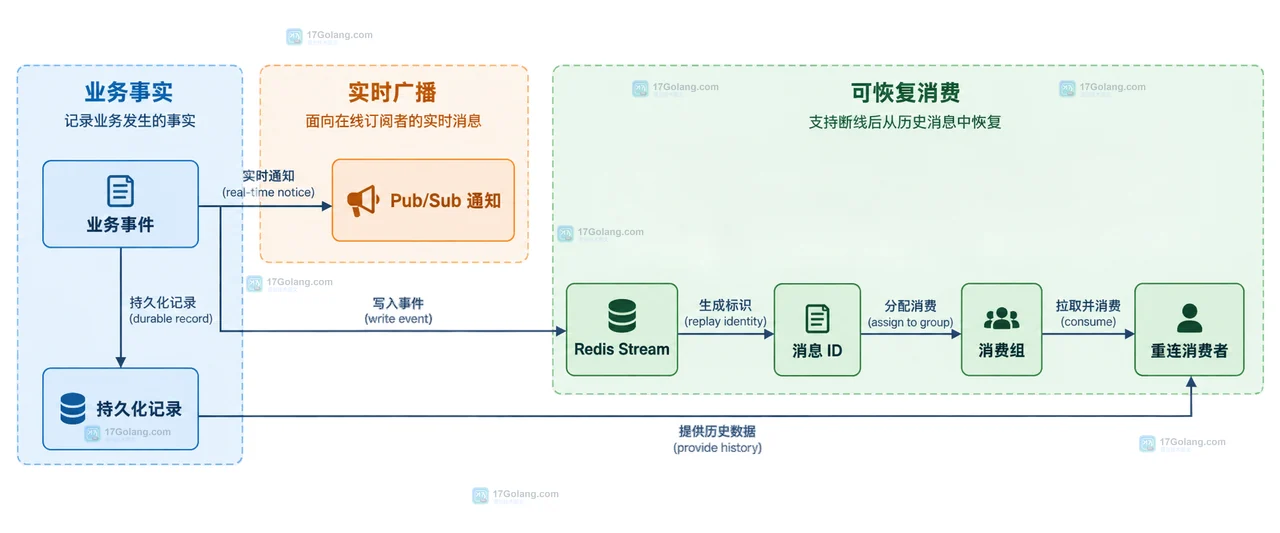
- Redis Pub/Sub 订阅者断线后为什么收不到历史消息
- 287浏览 收藏
-
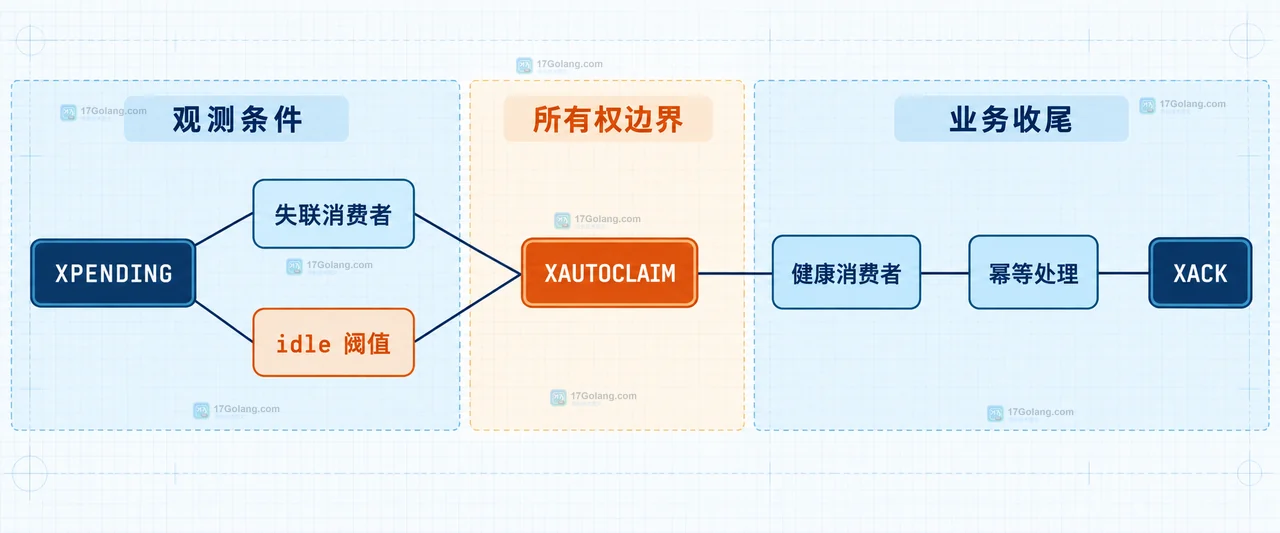
- 数据库 · Redis | 5小时前 | Redis · 消息队列 · Stream · 消费组 · XREADGROUP XACK XPENDING XAUTOCLAIM Redis Streams Pending List
- Redis Streams XREADGROUP 后 Pending List 怎么处理
- 342浏览 收藏
-
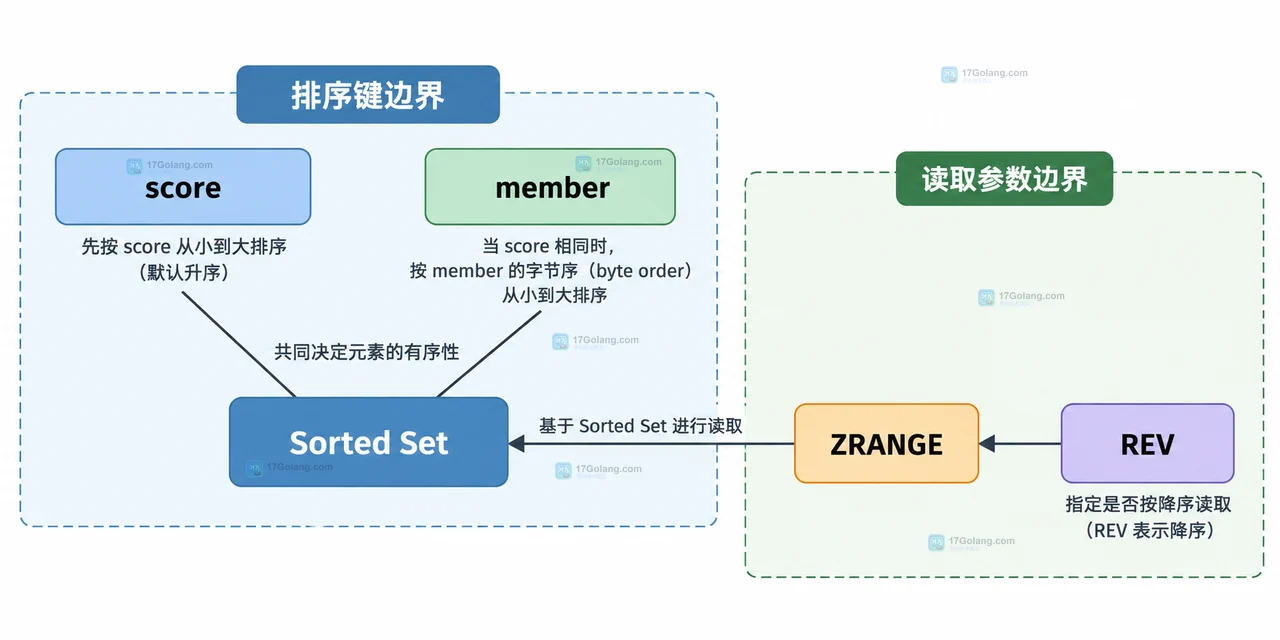
- 数据库 · Redis | 6小时前 | Redis · 排行榜 · Sorted Set · 分页设计 · 游标分页 · redis 分页 limit rev ZRANGE Sorted Set
- Redis Sorted Set 分数相同时怎么保证分页稳定
- 349浏览 收藏
-
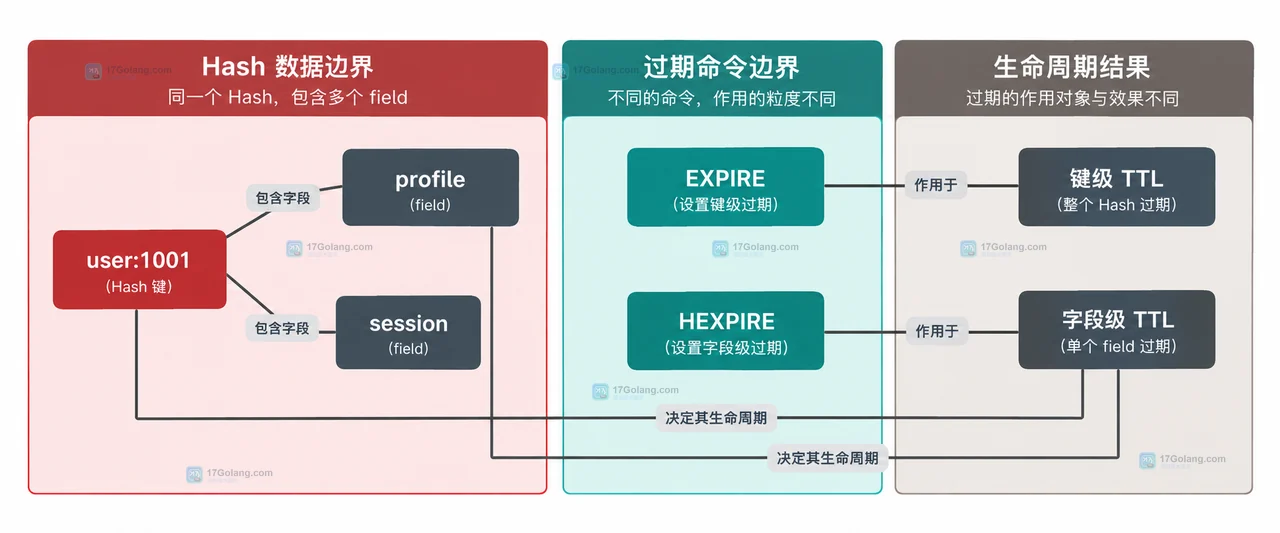
- 数据库 · Redis | 7小时前 |
- Redis Hash 只给单个 field 设置过期时间为什么不行
- 456浏览 收藏
-
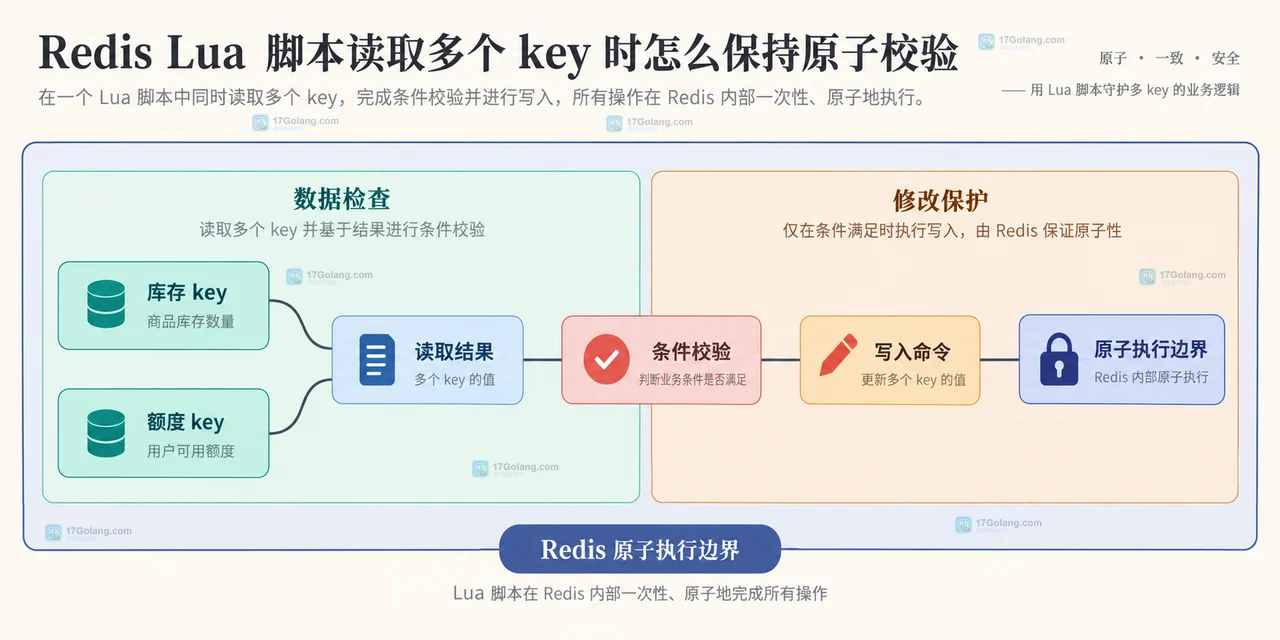
- 数据库 · Redis | 17小时前 | Redis · lua · eval · eval Redis Lua 多 key 原子校验
- Redis Lua 脚本读取多个 key 时怎么保持原子校验
- 423浏览 收藏
-
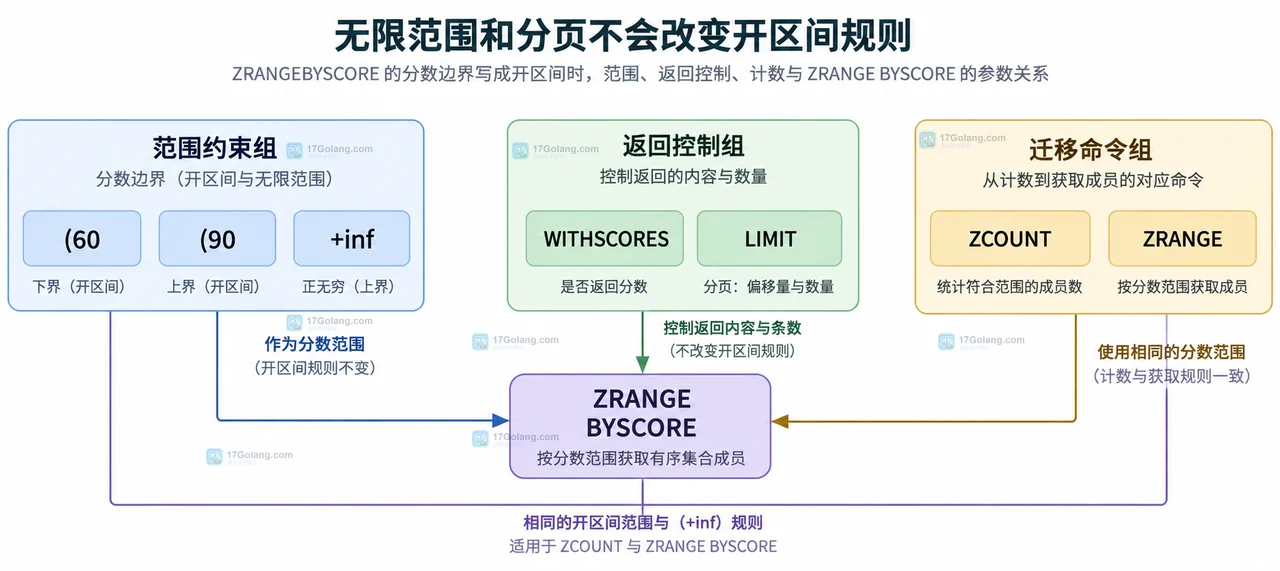
- 数据库 · Redis | 1天前 |
- Redis ZRANGEBYSCORE 分数边界怎么写成开区间
- 440浏览 收藏
-
- 前端进阶之JavaScript设计模式
- 设计模式是开发人员在软件开发过程中面临一般问题时的解决方案,代表了最佳的实践。本课程的主打内容包括JS常见设计模式以及具体应用场景,打造一站式知识长龙服务,适合有JS基础的同学学习。
- 543次学习
-
- GO语言核心编程课程
- 本课程采用真实案例,全面具体可落地,从理论到实践,一步一步将GO核心编程技术、编程思想、底层实现融会贯通,使学习者贴近时代脉搏,做IT互联网时代的弄潮儿。
- 516次学习
-
- 简单聊聊mysql8与网络通信
- 如有问题加微信:Le-studyg;在课程中,我们将首先介绍MySQL8的新特性,包括性能优化、安全增强、新数据类型等,帮助学生快速熟悉MySQL8的最新功能。接着,我们将深入解析MySQL的网络通信机制,包括协议、连接管理、数据传输等,让
- 500次学习
-
- JavaScript正则表达式基础与实战
- 在任何一门编程语言中,正则表达式,都是一项重要的知识,它提供了高效的字符串匹配与捕获机制,可以极大的简化程序设计。
- 487次学习
-
- 从零制作响应式网站—Grid布局
- 本系列教程将展示从零制作一个假想的网络科技公司官网,分为导航,轮播,关于我们,成功案例,服务流程,团队介绍,数据部分,公司动态,底部信息等内容区块。网站整体采用CSSGrid布局,支持响应式,有流畅过渡和展现动画。
- 485次学习
-
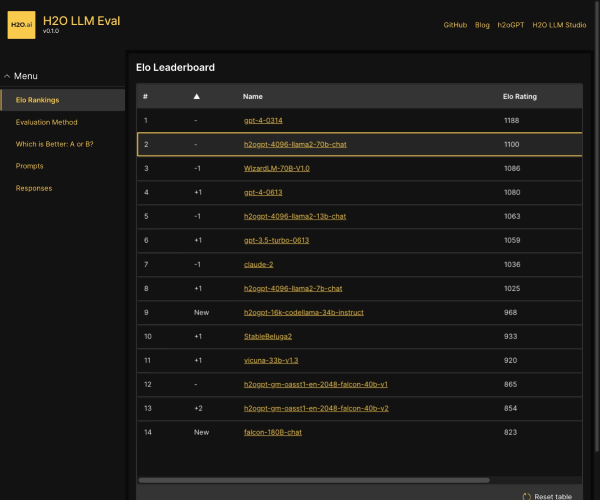
- H2O EvalGPT
- H2O EvalGPT是H2O.ai推出的开源LLM评估平台,提供详细的大模型性能排行榜、行业特定基准测试及A/B测试功能,助您快速选择最适合项目的高性能大语言模型。
- 70次使用
-
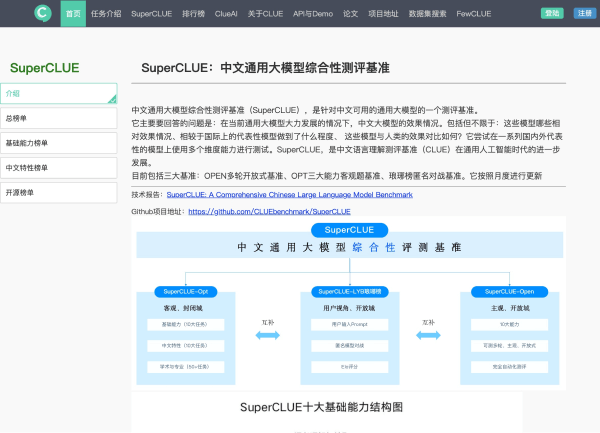
- SuperCLUE
- SuperCLUE是权威的中文大语言模型综合评测基准,涵盖语言理解、知识应用、AI Agent智能体及安全性等12项核心能力。通过多轮对话与客观测试,定期发布榜单与技术报告,为模型研发、优化及行业选型提供科学依据。
- 227次使用
-

- C-Eval
- 深入了解C-Eval中文评估套件,涵盖52个学科与4级难度。本文详解其功能特点、Zero-shot/Few-shot使用方法及代码示例,助您全面评测LLM中文理解与泛化能力。
- 153次使用
-

- AI Prompt Library
- 探索AI Prompt Library免费资源库,涵盖营销、写作及多场景AI提示词。兼容ChatGPT、Claude等工具,一键复制优化输出,提升工作效率。
- 83次使用
-

- Generrated
- Generrated汇集9300+张DALL·E生成图像及对应提示词,支持查看完整图集、对比DALL·E 2与3版本差异,是AI绘图新手学习Prompt设计与获取创作灵感的实用工具。
- 63次使用
-
- 接口返回的数据和数据库不一致怎么办?按数据生命周期排查
- 2026-06-27 398浏览
-
- 关于golangtest缓存问题
- 2023-01-01 298浏览
-
- Go语言基于HTTP的内存缓存服务的实现
- 2022-12-24 388浏览
-
- 使用Go实现健壮的内存型缓存的方法
- 2022-12-29 420浏览
-
- Go singleflight 怎么合并同一请求:缓存失效时别让 500 个请求一起回源
- 2026-07-17 109浏览