【MySQL 源码】UNION 比 UNION ALL 的性能差很多吗?
在数据库实战开发的过程中,我们经常会遇到一些这样那样的问题,然后要卡好半天,等问题解决了才发现原来一些细节知识点还是没有掌握好。今天golang学习网就整理分享《【MySQL 源码】UNION 比 UNION ALL 的性能差很多吗?》,聊聊MySQL、源码、MySQL优化、C++、源码分析,希望可以帮助到正在努力赚钱的你。
原文地址: 【MySQL 源码】UNION 比 UNION ALL 的性能差很多吗?
欢迎访问我的个人博客: http://blog.duhbb.com/
引言
本文从源码角度分析了一下 MySQL 中 union 和 union all 的区别;得出了以下结论: union 和 union all 都会创建临时表, 但是又不太一样; 二者的查询计划不一样;union 默认会创建一个以返回列作为 key 的临时表, 所谓过滤就是将数据插入这个临时表; 临时表装数据的容器实际上是一个 unordered_set; 有一种存储引擎叫做临时表; union all 则是直接读取表的数据并返回给客户端, 不走临时表; union all 和 union 的场景还是得根据需要来判断, 如果没有 distinct 的需求话, 数据又不多, 可以考虑使用 union all.
Union 和 Union All 的区别
Union 和 Union All 之间的唯一区别是 Union All 不会删除重复的行或记录, 而是从所有表中选择满足您的具体查询条件的所有行并将它们组合到结果表中.
UNION 不适用于具有文本数据类型的列. 而 UNION ALL 适用于所有数据类型列.
MySQL 官方介绍
MySQL 官方文档在介绍 12.5 Non-Subquery UNION Execution 是这么说的:
非子查询联合 (non-subquery unions) 是在
void Query_expression::create_access_paths(THD *thd) {

  // 确定我们是否可以流式读取行, 即永远不需要将它们放到临时表中
  // 如果可以的话, 我们会首先物化 UNION DISTINCT blocks, 然后将剩余任何 UNION ALL block
  // 通过 AppendIterator 追加.
  //
  // 如果不能流式的话, 即每个块都必须进入临时表
  // 我们对于混合的 UNION ALL/DISTINCT 的策略有点不同
  // 详情见 MaterializeIterator.
  bool streaming_allowed = true;
  if (global_parameters()->order_list.size() != 0) {
    // If we're sorting, we currently put it in a real table no matter what.
    // This is a legacy decision, because we used to not know whether filesort
    // would want to refer to rows in the table after the sort (sort by row ID).
    // We could probably be more intelligent here now.
    streaming_allowed = false;
  }


  // 省略前面

  // 如果允许流式查询, 那么我们可以对 UNION ALL 的每个部分都做流式查询,
  // 而其他情况则都需要用到临时表.
  //
  // 处理我们需要物化的所有的 query block.
  // 这个可能是 UNION DISTINCT 的 query block 或者所有的 block.

  if (union_distinct != nullptr || ! streaming_allowed) {
    Mem_root_array<:queryblock> query_blocks =
        setup_materialization(thd, tmp_table, streaming_allowed);

  // 省略后面
光看代码感觉一头雾水, 还是 debug 一下吧.
  if (! simple_query_expression) {
    /*
      Check that it was possible to aggregate all collations together for UNION.
      We need this in case of UNION DISTINCT, to filter out duplicates using
      the proper collation.

      TODO: consider removing this test in case of UNION ALL.
    */
    for (Item *type : types) {
      if (type->result_type() == STRING_RESULT &&
          type->collation.derivation == DERIVATION_NONE) {
        my_error(ER_CANT_AGGREGATE_NCOLLATIONS, MYF(0), "UNION");
        return true;
      }
    }
    ulonglong create_options =
        first_query_block()->active_options() | TMP_TABLE_ALL_COLUMNS;

    if (union_result->create_result_table(thd, types, union_distinct != nullptr,
                                          create_options, "", false,
                                          instantiate_tmp_table))
这里执行的语句是:
select * from student union select * from student;
可以看到这里确实创建了临时表, 是在
bool Query_expression::prepare(THD *thd, Query_result *sel_result,
创建临时表调用的是这个方法:
/**
Create a temp table according to a field list.
Given field pointers are changed to point at tmp_table for
send_result_set_metadata. The table object is self contained: it's
allocated in its own memory root, as well as Field objects
created for table columns. Those Field objects are common to TABLE and
TABLE_SHARE.
This function will replace Item_sum items in 'fields' list with
corresponding Item_field items, pointing at the fields in the
temporary table, unless save_sum_fields is set to false.
The Item_field objects are created in THD memory root.
@param thd thread handle
@param param a description used as input to create the table
@param fields list of items that will be used to define
column types of the table (also see NOTES)
@param group Group key to use for temporary table, NULL if
none
@param distinct should table rows be distinct
@param save_sum_fields see NOTES
@param select_options
@param rows_limit
@param table_alias possible name of the temporary table that can
be used for name resolving; can be "".
@remark mysql_create_view() checks that views have less than
MAX_FIELDS columns.
@remark We may actually end up with a table without any columns at all.
See comment below: We don't have to store this.
*/
#define STRING_TOTAL_LENGTH_TO_PACK_ROWS 128
#define AVG_STRING_LENGTH_TO_PACK_ROWS 64
#define RATIO_TO_PACK_ROWS 2
TABLE *create_tmp_table(THD *thd, Temp_table_param *param,
const mem_root_deque- &fields, ORDER *group,
bool distinct, bool save_sum_fields,
ulonglong select_options, ha_rows rows_limit,
const char *table_alias) {
其中有一段代码是这样的:
  } else if (distinct && share->fields != param->hidden_field_count) {
    /*
      Create an unique key or an unique constraint over all columns
      that should be in the result.  In the temporary table, there are
      'param->hidden_field_count' extra columns, whose null bits are stored
      in the first 'hidden_null_pack_length' bytes of the row.
    */
    DBUG_PRINT("info", ("hidden_field_count: %d", param->hidden_field_count));
    share->keys = 1;
    share->is_distinct = true;
    if (! unique_constraint_via_hash_field) {
      param->keyinfo->table = table;
      param->keyinfo->is_visible = true;
      param->keyinfo->user_defined_key_parts =
          share->fields - param->hidden_field_count;
      param->keyinfo->actual_key_parts = param->keyinfo->user_defined_key_parts;
      KEY_PART_INFO *key_part_info = share->mem_root.ArrayAlloc(
          param->keyinfo->user_defined_key_parts);
      if (key_part_info == nullptr) return nullptr;
      param->keyinfo->key_part = key_part_info;
      param->keyinfo->flags = HA_NOSAME | HA_NULL_ARE_EQUAL;
      param->keyinfo->actual_flags = param->keyinfo->flags;
      param->keyinfo->name = "";
      // keyinfo->algorithm is set later, when storage engine is known
      param->keyinfo->set_rec_per_key_array(nullptr, nullptr);
      param->keyinfo->set_in_memory_estimate(IN_MEMORY_ESTIMATE_UNKNOWN);


      /* 关键之处: 给我们想要返回的列搞一个整体的 distinct key */
      for (unsigned i = param->hidden_field_count; i fields;
           i++, key_part_info++) {
        key_part_info->init_from_field(table->field[i]);
        if (key_part_info->store_length > max_key_part_length) {
          unique_constraint_via_hash_field = true;
          break;
        }
      }
      table->key_info = param->keyinfo;
      share->key_info = param->keyinfo;
      share->key_parts = param->keyinfo->user_defined_key_parts;
    }
  }
感觉从这里似乎理解了 MySQL 是如何做过滤的了, 它会创建一个临时表, 然后给要返回的字段建一个
Hash_unique::Hash_unique(const Table &table, const KEY &mysql_index,
                         const Allocator &allocator)
    : Index(table, mysql_index),
      m_hash_table(INDEX_DEFAULT_HASH_TABLE_BUCKETS, Indexed_cells_hash(*this),
                   Indexed_cells_equal_to(*this), allocator) {}

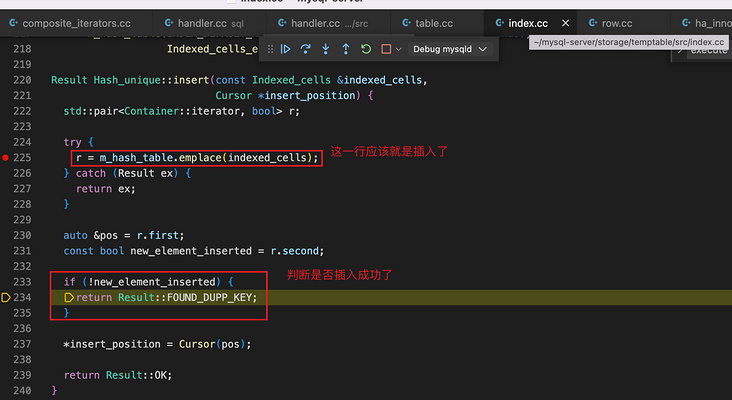
Result Hash_unique::insert(const Indexed_cells &indexed_cells,
                           Cursor *insert_position) {
  std::pair<:iterator bool> r;

  try {
    // m_hash_table 就是个 unordered_set
    r = m_hash_table.emplace(indexed_cells);
  } catch (Result ex) {
    return ex;
  }

  auto &pos = r.first;
  const bool new_element_inserted = r.second;

  // 就是这里了, 判断是否插入成功
  if (! new_element_inserted) {
    return Result::FOUND_DUPP_KEY;
  }

  *insert_position = Cursor(pos);

  return Result::OK;
}
上面这个代码的路径是在: /Users/tuhooo/mysql-server/storage/temptable/src/index.cc
贴个图片纪念一下:
它喵的, 这个临时表保存记录其实就是用了一个
      /**
       *  @brief Attempts to build and insert an element into the
       *  %unordered_set.
       *  @param __args  Arguments used to generate an element.
       *  @return  A pair, of which the first element is an iterator that points
       *           to the possibly inserted element, and the second is a bool
       *           that is true if the element was actually inserted.
       *
       *  This function attempts to build and insert an element into the
       *  %unordered_set. An %unordered_set relies on unique keys and thus an
       *  element is only inserted if it is not already present in the
       *  %unordered_set.
       *
       *  Insertion requires amortized constant time.
       */
      template
    std::pair
    emplace(_Args&&... __args)
    { return _M_h.emplace(std::forward<_args>(__args)...); }
临时表其实是一种存储引擎.
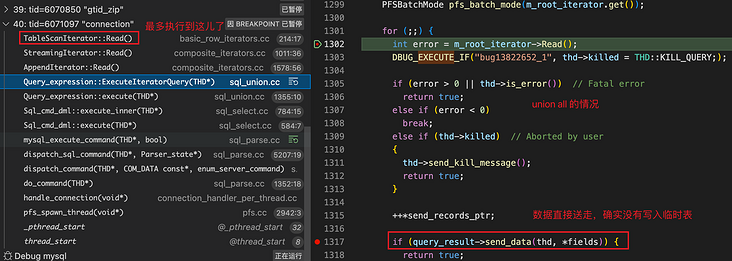
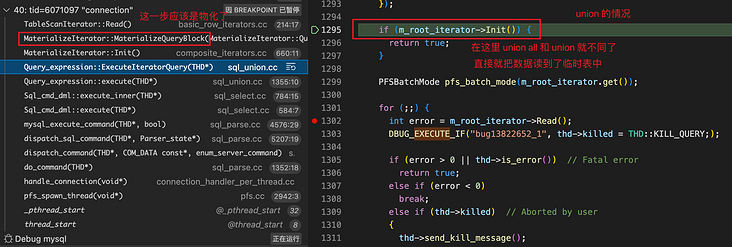
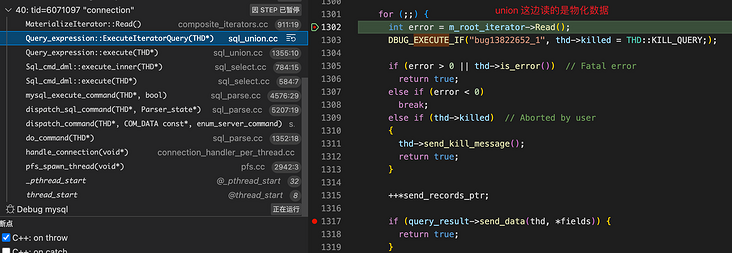
本质上还是创建的查询计划不一样, 就是在下边这段代码了:
    m_root_iterator = CreateIteratorFromAccessPath(
        thd, m_root_access_path, join, /*eligible_for_batch_mode=*/true);
    if (m_root_iterator == nullptr) {
      return true;
    }
它来自于: sql_union.cc 中的 optimize 方法:
bool Query_expression::optimize(THD *thd, TABLE *materialize_destination,
                                bool create_iterators,
                                bool finalize_access_paths) {
查询计划
union all
mysql> explain select * from student union all  select * from student \G;
*************************** 1. row ***************************
           id: 1
  select_type: PRIMARY
        table: student
   partitions: NULL
         type: ALL
possible_keys: NULL
          key: NULL
      key_len: NULL
          ref: NULL
         rows: 1
     filtered: 100.00
        Extra: NULL
*************************** 2. row ***************************
           id: 2
  select_type: UNION
        table: student
   partitions: NULL
         type: ALL
possible_keys: NULL
          key: NULL
      key_len: NULL
          ref: NULL
         rows: 1
     filtered: 100.00
        Extra: NULL
2 rows in set, 1 warning (6.53 sec)

ERROR:
No query specified

mysql> show warnings;
+-------+------+-----------------------------------------------------------------------------------------------------------------------------------------------------------------------------------------------------------------------------------------------------------------------------------------------------------+
| Level | Code | Message                                                                                                                                                                                                                                                                                                   |
+-------+------+-----------------------------------------------------------------------------------------------------------------------------------------------------------------------------------------------------------------------------------------------------------------------------------------------------------+
| Note  | 1003 | /* select#1 */ select `test`.`student`.`id` AS `id`,`test`.`student`.`name` AS `name`,`test`.`student`.`phone` AS `phone` from `test`.`student` union all /* select#2 */ select `test`.`student`.`id` AS `id`,`test`.`student`.`name` AS `name`,`test`.`student`.`phone` AS `phone` from `test`.`student` |
+-------+------+-----------------------------------------------------------------------------------------------------------------------------------------------------------------------------------------------------------------------------------------------------------------------------------------------------------+
1 row in set (3.24 sec)
union
mysql> explain select * from student union   select * from student \G;
*************************** 1. row ***************************
           id: 1
  select_type: PRIMARY
        table: student
   partitions: NULL
         type: ALL
possible_keys: NULL
          key: NULL
      key_len: NULL
          ref: NULL
         rows: 1
     filtered: 100.00
        Extra: NULL
*************************** 2. row ***************************
           id: 2
  select_type: UNION
        table: student
   partitions: NULL
         type: ALL
possible_keys: NULL
          key: NULL
      key_len: NULL
          ref: NULL
         rows: 1
     filtered: 100.00
        Extra: NULL
*************************** 3. row ***************************
           id: NULL
  select_type: UNION RESULT
        table:
   partitions: NULL
         type: ALL
possible_keys: NULL
          key: NULL
      key_len: NULL
          ref: NULL
         rows: NULL
     filtered: NULL
        Extra: Using temporary
3 rows in set, 1 warning (7.19 sec)

ERROR:
No query specified

mysql> show warnings;
+-------+------+-------------------------------------------------------------------------------------------------------------------------------------------------------------------------------------------------------------------------------------------------------------------------------------------------------+
| Level | Code | Message                                                                                                                                                                                                                                                                                               |
+-------+------+-------------------------------------------------------------------------------------------------------------------------------------------------------------------------------------------------------------------------------------------------------------------------------------------------------+
| Note  | 1003 | /* select#1 */ select `test`.`student`.`id` AS `id`,`test`.`student`.`name` AS `name`,`test`.`student`.`phone` AS `phone` from `test`.`student` union /* select#2 */ select `test`.`student`.`id` AS `id`,`test`.`student`.`name` AS `name`,`test`.`student`.`phone` AS `phone` from `test`.`student` |
+-------+------+-------------------------------------------------------------------------------------------------------------------------------------------------------------------------------------------------------------------------------------------------------------------------------------------------------+
1 row in set (4.04 sec)
嘿嘿, 刚好又把我之前学的一点点
explain知识给串起来了.
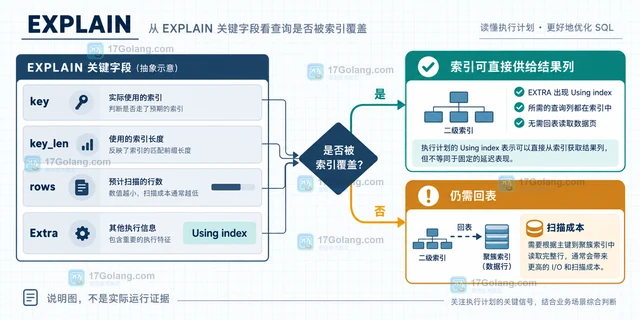
Extra: Using temporary表示使用了临时表.
Using temporary
为了解析查询, MySQL 需要创建一个临时表来保存结果. 如果查询包含以不同方式列出列的 GROUP BY 和 ORDER BY 子句, 通常会发生这种情况.
如果对于查询计划不熟悉的, 可以参考我翻译和整理的这篇博客: 【MySQL 文档翻译】理解查询计划
总结
- union 和 union all 都会创建临时表, 但是又不太一样
- 二者的查询计划不一样
- union 默认会创建一个以返回列作为 key 的临时表, 所谓过滤就是将数据插入这个临时表
- 临时表装数据的容器实际上是一个 unordered_set
- 有一种存储引擎叫做临时表
- union all 则是直接读取表的数据并返回给客户端, 不走临时表
- union all 和 union 的场景还是得根据需要来判断, 如果没有 distinct 的需求话, 数据又不多, 可以考虑使用 union all
原文地址: 【MySQL 源码】UNION 比 UNION ALL 的性能差很多吗?
欢迎访问我的个人博客: http://blog.duhbb.com/
以上就是《【MySQL 源码】UNION 比 UNION ALL 的性能差很多吗?》的详细内容,更多关于mysql的资料请关注golang学习网公众号!
 记一次FreeBSD系统中mysql服务异常的排查过程
- 上一篇
- 记一次FreeBSD系统中mysql服务异常的排查过程
- 下一篇
- 雪花算法(SnowFlake)
-
- 数据库 · MySQL | 2天前 | MySQL · 执行计划 · 慢查询 · MySQL EXPLAIN ANALYZE MySQL估算行数实际行数 MySQL执行计划耗时 MySQL慢查询诊断 MySQL TREE执行计划
- MySQL EXPLAIN ANALYZE对比估算行数与实际耗时的实现方法
- 262浏览 收藏
-
- 数据库 · MySQL | 2天前 |
- MySQL CHECK 约束上线前清理不符合约束的旧数据的实现方法
- 475浏览 收藏
-
- 数据库 · MySQL | 2天前 |
- MySQL 在线 DDL评估加索引时的锁与空间的实现方法
- 202浏览 收藏
-
- 数据库 · MySQL | 2天前 | MySQL · ROW_NUMBER PARTITION BY MySQL 窗口函数 每组最新记录 分组取最新
- MySQL 窗口函数按分组取每组最新记录的实现方法
- 185浏览 收藏
-
- 数据库 · MySQL | 2天前 | MySQL · mysql 临时表 Performance Schema temptable_max_ram tmp_table_size
- MySQL temptable_max_ram 观察临时表内存阈值如何设置
- 409浏览 收藏
-
- 数据库 · MySQL | 2天前 | MySQL · 索引优化 · mysql Invisible Index 索引可见性
- MySQL invisible index 试验结束后如何恢复可见
- 118浏览 收藏
-
- 数据库 · MySQL | 2天前 |
- MySQL 角色继承权限后 SHOW GRANTS 如何解读
- 101浏览 收藏
-
- 数据库 · MySQL | 2天前 |
- MySQL 复制状态中 Retrieved_Gtid_Set 如何辅助定位缺口
- 221浏览 收藏
-
- 数据库 · MySQL | 2天前 | MySQL · mysql Performance Schema events_statements 平均耗时
- MySQL Performance Schema events_statements 如何找平均耗时
- 125浏览 收藏
-
- 数据库 · MySQL | 3天前 |
- MySQL LOAD DATA 导入 TSV 时如何处理字段内制表符
- 253浏览 收藏
-

- 前端进阶之JavaScript设计模式
- 设计模式是开发人员在软件开发过程中面临一般问题时的解决方案,代表了最佳的实践。本课程的主打内容包括JS常见设计模式以及具体应用场景,打造一站式知识长龙服务,适合有JS基础的同学学习。
- 543次学习
-

- GO语言核心编程课程
- 本课程采用真实案例,全面具体可落地,从理论到实践,一步一步将GO核心编程技术、编程思想、底层实现融会贯通,使学习者贴近时代脉搏,做IT互联网时代的弄潮儿。
- 516次学习
-

- 简单聊聊mysql8与网络通信
- 如有问题加微信:Le-studyg;在课程中,我们将首先介绍MySQL8的新特性,包括性能优化、安全增强、新数据类型等,帮助学生快速熟悉MySQL8的最新功能。接着,我们将深入解析MySQL的网络通信机制,包括协议、连接管理、数据传输等,让
- 500次学习
-
- JavaScript正则表达式基础与实战
- 在任何一门编程语言中,正则表达式,都是一项重要的知识,它提供了高效的字符串匹配与捕获机制,可以极大的简化程序设计。
- 487次学习
-

- 从零制作响应式网站—Grid布局
- 本系列教程将展示从零制作一个假想的网络科技公司官网,分为导航,轮播,关于我们,成功案例,服务流程,团队介绍,数据部分,公司动态,底部信息等内容区块。网站整体采用CSSGrid布局,支持响应式,有流畅过渡和展现动画。
- 485次学习
-

- PubMedQA
- 深入了解PubMedQA生物医学问答数据集,涵盖其核心功能、使用方法及在临床决策、药物研发等场景的应用,助力提升NLP模型性能。
- 90次使用
-
- H2O EvalGPT
- H2O EvalGPT是H2O.ai推出的开源LLM评估平台,提供详细的大模型性能排行榜、行业特定基准测试及A/B测试功能,助您快速选择最适合项目的高性能大语言模型。
- 177次使用
-

- LMArena
- LMArena是加州大学伯克利分校推出的AI模型匿名评测平台。通过盲测投票机制,用户可对比不同大模型回答并生成实时排行榜,助力开发者优化模型及用户选择最佳AI工具。
- 113次使用
-
- HELM
- 深入了解斯坦福推出的HELM(Holistic Evaluation of Language Models)大模型评测体系。本文解析其核心功能、安装配置步骤及应用场景,涵盖准确性、公平性、鲁棒性等多维度指标,助力开发者全面优化语言模型性能。
- 89次使用
-
- CMMLU
- 深入了解CMMLU中文评估基准,涵盖67个学科主题,提供数据集下载、Zero-shot/Five-shot评估方法及排行榜,助力优化中文语言模型性能。
- 68次使用
-
- MySQL 明明加了索引,为什么查询还是很慢?先查这 6 个点
- 2026-06-27 374浏览
-
- golang MySQL实现对数据库表存储获取操作示例
- 2022-12-22 499浏览
-
- golang 基于 mysql 简单实现分布式读写锁
- 2023-01-07 384浏览
-
- 详解如何利用GORM实现MySQL事务
- 2023-01-07 184浏览
-
- Go语言实现操作MySQL的基础知识总结
- 2023-01-23 265浏览